Reed Turchi
Interview with Reed Turchi
by Faith Palermo
Faith Palermo: As you’re someone who has published many poems and released quite a lot of music, I was wondering about how the writing process differs between poetry and music. When starting a piece, how do you know if it’ll be a song or a poem?
Reed Turchi: That distinction is something that I’m reapproaching and reconsidering. In both cases, I’m pretty sonically guided. I’ve had people ask if they’re the same thing, if the songs become poems or if the poems become songs. That’s something I’m interested in, but it hasn’t been the case for me, at least so far. I’d like my poems to have all the music within them, within the language, whether that’s with stress patterns or internal rhyme schemes, official or unofficial. All those kinds of sonic linking. For me, in a poem, all those elements are happening within the language.
On the song side, I usually start with the musical idea, an idea on an instrument. This creates the feeling of the sound that then leads me to think about the type of story or emotional expression the song could show, the lyrics that would fit with that sound.
In both cases, I start with the sound. If I’ve written an opening line with a certain rhythm or feeling to it, it’ll be a poem. If I find something on guitar, my primary instrument, with an engaging sound, that would be the start of a song. Most of this is by ear. If I hear words with a lot of sound in them, I’ll start with poetry. If there’s more of a musical feeling, it’s more of a song.
That’s how I’ve thought about it so far, but I’m also interested in experimenting with other ways that poems and songs can talk to each other.
FP: There’s so much texture in all of your work. Having read your poetry (and having listened to you read your poetry), those internal sonics really shine through. Your music being based around another source of texture, and the way that that interacts with the lyrics is really interesting.
RT: I think so too, or I try to keep it that way.
FP: In thinking about genre, do you find that it impacts the different realms of your work differently? The sound that you’ve cultivated in your music is very specific, as is the voice and tone that you’ve developed through your poetry. Do you find yourself leaning towards different elements of craft in thinking about genre?
RT: Yes. Starting on the music side, I grew up playing piano, and then at some point really fell in love with this very specific type of slide guitar playing and this music that comes from North Mississippi. I was down there for a while, then I was in Memphis. I’ve had these geographically focused music interests, and I tend to be drawn towards idiosyncratic players, which makes my own development and learning harder. I don’t have a formal music background. I mainly find a sound I really like and try to figure out how the artist made it.
There’s always a few curveballs. It usually has to do with a tuning or a place in time or other parameters that aren’t so obvious. This genre of music has become a sound and stylistic base for me, rooted in those more geographic styles. Although, I just finished a session in Nashville this weekend, which maybe will have pushed out of that a little bit. We’ll see.
On the poetry side, it’s less clear. There are some voices that are really loud in my head, which include Ellen Bryant Voigt, Larry Levis, Tom Lux, and Heather McHugh, although I don’t think I have the quality of word play that she does. Maurice Manning and Rodney Jones too. Larry Levis is more known for his digressive voice, but all those poets are pretty constantly aware of their iambic metrical play. Ellen, Maurice, and Rodney would also all qualify as southern poets, at least at some part of their career, so there’s a storytelling element that’s going to happen within a very metrical-y, sound type poem. I wouldn’t say that’s my genre, but those are definitely the voices I tend to hear loudest, at least at this stage in my writing.
Then there are other poems that are a little more weird. I was very sick for a while, so I was really high on prednisone for about a year, which was a pretty wild experience. During that period, I got really enamoured with Robert Lowell’s sonnets. I think Lowell is pretty brutally out of fashion right now, and I don’t know if I feel a huge affinity towards some of his big poem projects. His sonnets were written while he was going in and out of asylums and dealing with different manic episodes, and the syntax and word play, alongside the internal rhythms of those sonnets, really matched with where my brain was in its prednisone state. That stuff is maximum torque – every word, every line, there’s a lot of torque and energy behind it. What I also really liked about his sonnets, and what I tried to replicate in my own work, is that he writes them about every subject matter. The linguistic force is equal, whether it’s a very big life or death subject or a bug flying around a kitchen. Either way, there’s this maximumal linguistic energy. I think that’s a realm I slip into with some of the poems in the book too.
FP: It’s clear that community is something that’s steeped into all levels of your work, so it’s really lovely to hear about the different ways that individual musicians and poets inspire you, while also speaking towards a broader geographical community.
RT: It’s the only way I know!
FP: Earlier you mentioned the narrative elements that appear in much of your work. As someone who mainly writes nonfiction, I really love to see the different ways that nonfiction and memoir appear across different genres. Your poems “Jared” and “Lightning Takes the Form of Hope” especially stick out as pieces that integrate narrative nonfiction and memoir. From an outside perspective, it seems that much of your poetry utilizes nonfiction, while your music feels a bit separate. Is there much overlap or is the difference in audience a factor?
RT: Those two poems are interesting – I’m visualizing them on the page, and they take a similar shape. For “Lightning Takes the Form of Hope,” this might sound obnoxious, but that’s pretty much the first draft. For “Jared,” the published version is maybe the 800th draft. I reworked that poem so many times, and it’s taken so many different forms. It’s funny; those are both based in narrative events. “Lightning Takes the Form of Hope” was a little easier because it was one elongated moment. I had a lot more difficulty trying to figure out how to integrate the temporal and perspective moves that happen in “Jared.” Balancing the amount of contextual information given on the speaker’s life to make sure that it doesn’t bog down the most dramatic aspect of the piece (watching this thing happen, even though it’s mediated through a screen and a lot of unknowing) was tricky.
On the music side, there are some songs that are more narrative based, that set out to tell a story. A couple that I was working on this weekend really fall nicely into that camp.There are others that are a bit more cyclical. A lot of the music I love is hypnotic, in that it circles around one or two things, both musically and lyrically. Sometimes, the music is vamping or droning over these themes, and the lyrics are more repetitive to mirror that circling.
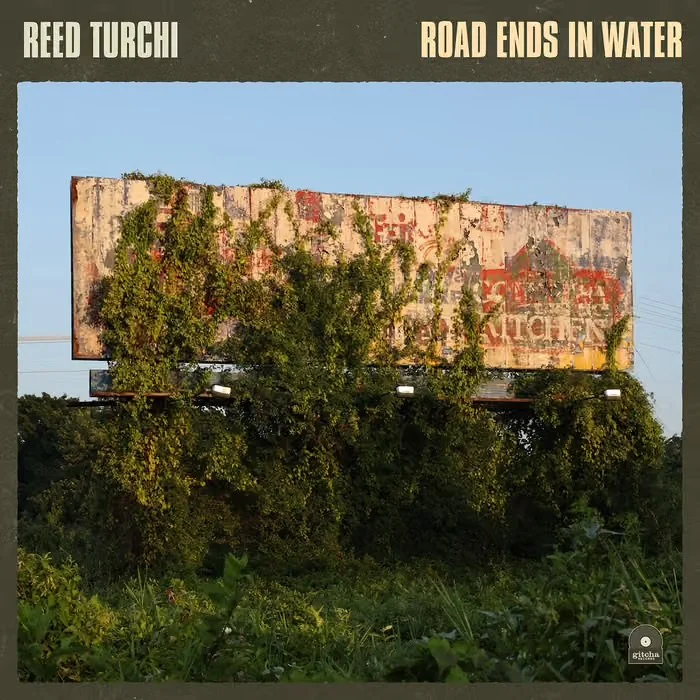
This new album that’s coming out in October, Road Ends in Water, is actually an old album that’s just seeing the light of day again. It’s funny to me, because that’s an album that I first wrote and recorded when I was 18, and there’s a lot of storytelling in the songs. I was reworking another old song this past weekend, and the other musicians I was with noted it was basically one of my poems. It made me realize that this has been my mode for a while. I’m not sure if I’m finding my way back to that, or if I’m just finding different ways to get narrative.
Something else that songs offer that poems don’t, at least our contemporary sense of poetry doesn’t offer, is choruses. Songs have choruses, obviously, but in poetry, how can we do narrative moves between choral moments? I’ve been trying to let myself lean more into repetition in new poem drafts and treat that as a type of chorus. As a poet, I find myself hyperaware of my own repetitions and often want to scratch them out because they feel too obvious or too redundant or repetitive. While it can be, I feel like if a reader encounters a poem that I’ve dubbed as “too repetitive,” that’s the structural element that draws them in. In that way, even if the repetition is just a word, it acts as a song chorus would. I’ve been trying to let myself live with that more in poems, to keep them from flowing straight down, and to create circling within them as the poems progress.
In“Jared,” it’s all the allusions to fire. He props the fire door open. He exhausts blunt smoke from the control room. The song that he’s relearning is “Ring of Fire.” How many of those things can go in the poem to emphasize the most dramatic and traumatic events of the poem? That tone has been set, hopefully not in a way that makes it dumb or obvious. All those nods have prepared the reader for the self-immolation to happen.
FP: That’s really interesting! Thinking about the different ways to “condition” the reader to nod towards something, leaving space for repetition without it feeling too heavy handed.
While we’re talking about the editing process, I’m curious about how different forms of editing impact your work. You briefly touched upon this in an interview with the Blues Rock Review a couple of weeks ago. One moment that stood out for me was your reflection on the rerecording process of Road Ends in Water. You noted that your “goal was never to improve upon the original recording, but rather to create something that honors the past while reflecting who [you are] as an artist,” followed by a paraphrased quote from Ellen Bryant Voigt: “to dig a hole to the past is to bury the living grass on either side.” This seems particularly fitting as the original album still exists in the world.
I found this really compelling, and I’m curious as to how this relates to your poetry practice. This has come up in some of your other responses, but you’ve also touched on this on social media. You recently had the poem “Self-Storage” published in The Asheville Poetry Review, and on Instagram you noted that the piece had gone through several rounds of revisions over the span of years. How were these processes – rerecording the album and revising poetry – different?
RT: They’re both pretty funky – I mean, what is a moment in time? Road Ends in Water was originally recorded in 2010, but the band I play with now and I relearned and recorded it for a video shoot. We had to rearrange the song; it was a different group, with different personnel, but it’s very interesting to go back.
There’s an analogy that I typically use to think about different mediums. With music, you press record and the microphone becomes a third party. What the microphone picks up may or may not be totally in line with what you’re consciously presenting out of your body. When you go back and listen, there’s all kinds of stuff that’s there or not there, that may or may not be what you thought was in the original. In poetry, I think it’s a little different because you can constantly tear apart and rewrite your poems. There isn’t a third party; there’s no microphone. It’s just you and the draft.
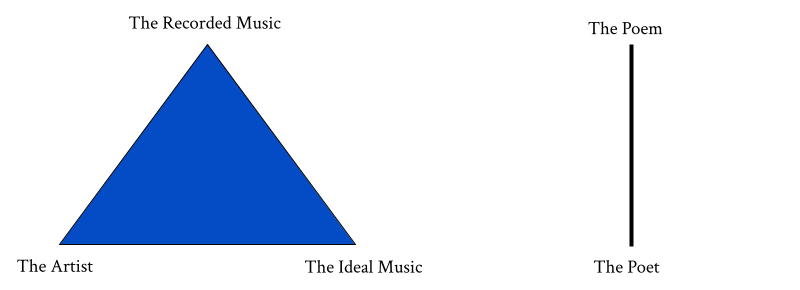
With music, there’s you as the artist, the music you’re trying to reach, and then there’s the recording. It forms a triangle. You could say the same thing for poetry in that there’s a poem in the ether that you’re trying to reach, but in terms of physical medium, you’re putting it directly on the page, instead of being overheard.
In revising poems, I try to learn from music writing. When recording music, artists typically create a “demo version” of the song. Then, they’ll go into the studio and work really hard on the track, but sometimes the demo ends up better. This trap is called “demoitis,” where the artist loves the demo more than the professionally put together “final” product. In some ways, I think that’s totally right. There can be something really compelling captured in a demo, but sometimes you need to keep revising until you go beyond it.
With poems, it’s similar. I’m trying hard to respect the weird things that happen in my own first drafts and not assume that tinkering will improve them. I find it’s a very delicate state to improve a first draft. I think it’s easy to make it more orderly, logical, or regular, or to cut out things that feel wrong, but most of the time, I find my process to be nonlinear. I tend to take a crazy route where I do several rounds of revisions, only to keep returning back to the first draft.
It’s a relationship I try to be conscious of because there are so many cool things that happen in first drafts that we aren’t in control of. I’ve been trying to get better at honoring those things and not messing them up in the name of bettering. If there’s a part of the first draft that’s poorly written and unintentionally confusing, then the edits need to delicately massage and improve those moments so the poem comes across without ironing out the interesting weird wrinkles that add texture.
FP: It’s interesting to think about the role of technology too, especially as it connects to recording music versus being alone with a poem, and the impact that has on the work.
Thinking about the difference in revision process, in 2024, you released the album Playing With the Spirit, a work that combined spoken word, improvisational jazz, and original poems. Was the process for that different? Were the poems also improv, or did you have more of a set plan going into it?
RT: That was an interesting project. Everyone who’s playing music on the album are people I’ve performed with in full ensembles, people I have rapport with. I showed up with printed poems, but much of the line breaks and meter were improvised to be symbiotic and reactive to what was happening in the music. I think my highest bar for that type of collaboration is ensuring that both sources build off of one another. Does it feel like the musical elements are profoundly improved and contributing to the words, and are the words reacting well? This process is tricky, and some pieces are more effective than others. It gets back to the same conundrum of words as sound art, where there are some fundamental differences between how songs and contemporary poems tend to be structured. I’m always wondering if lines are sonically pleasing to recite or if lines can serve as chorus repetitions with bigger motifs. In music, we talk about themes and variations all the time, and I think in poems, at least for the aesthetics that I have, it should be similar. You have patterns, then you break them. You build anticipation and recognition with the patterns, and when you break them, you create excitement.
It’s difficult. I have a session on the books for February 2027 to take on a version of Playing with the Spirit again, and we’ll see what I’ve learned since 2024. For me, it’s been good to have the poems stable enough that I know where they are, but I’m listening as much as possible to see if there are aspects to edit on the fly to match what’s happening rhythmically or melodically. If there's a big crescendo building that you can feel in the music, how can the poem be adjusted to have a dramatic event align? Playing With the Sprit had some real bright spots, and I’m excited to go even further in February.
FP: I’m excited to see what that’ll look like! In the poems that you’ll be working with, and those that you included in Playing with the Spirit, are they primarily unpublished or is it more of a combination?
RT: It’s a combination. In February, we’ll try to work off things from the book and other pieces that I can send to the musicians in advance. This time around, I think they’re going to do some advance scoring, if not note by note then at least by thinking about what’s in the poem and what it offers. The performance itself will be improvised, but I think we’ll try to build a world for each piece before we get into it.
The recording session will be in Memphis. “Self-Storage,” “Jared,” and a couple of other poems are very topically Memphis. Then, who knows! There’s no rules about it. We’ll see what feels right. At present, I’ve sent Art Edmaiston, my collaborator, the manuscript, and we’ll see what he pulls.
FP: Do you think the process for that would be similar to House of Unending, which you released in 2023 with Reginald Dwayne Betts, or was that project a bit different?
RT: In spirit, it’s similar. House of Unending is the same project, except I’m on the other side, playing guitar. There’s a lot of listening there. Dwayne is probably more of a rhythmic poet than I am – not all the time, but in many of his poems. For me, as the guitar player, I’m constantly wondering how I can introduce a musical theme that’s recognizable and solid enough to be part of a song or a riff but isn’t repetitive in a way that locks Dwayne into one rhythm or type of performance. One of the beauties of poetry as word art is there are so many ways to create change. You can adjust your tempo, use enjambment, vary your metrics within lines, and shift syntax. As a musician, I don’t want to introduce a guitar lick that’s too structured, causing Dwayne to be stuck repeating his approach.
Inversely, I hope that the musicians I’m working with, when I’m the one with words, offer me the same space, that I’m able to adjust my delivery in a way that works with the music.
FP: In thinking about being on both sides of that process, you’ve done a lot of work with other writers and musicians throughout the process of creation. You’re one of the editors at The Swannanoa Review, and you’ve done a lot of work producing music as well. I’m curious about how these areas intersect. How is working with writing on the page different from working with something sonic?
RT: At least for the editing that I’ve done so far with The Swannanoa Review, the big difference is that there’s only one voice at a time. Of course, there’s thought in assembling the issue, but each piece is one voice. The albums that I’ve fully produced have more moving parts. After listening to a solo demo version of the songs, I assemble the musicians that I think would be good for the project. Within the recording session, I help them find each other musically and spiritually within the performance. Maybe one drummer tends to have a certain type of feel, which would pair nicely with another specific artist. It’s more of an assembly that pays attention to each sound and how they accumulate together, really thinking about what the whole can be.
For The Swannanoa Review, we definitely thought about the issue as a whole, but an album is different. When you’re producing, you’re always trying to get 1 + 1 = 3. You’re trying to summon this magical other thing that happens. At least in my current moment, I would say that the magazine is more of 1 + 1 = 2. We want each piece to be good and to find its place, but in music, the whole as a unit matters a bit more.
Sequencing an album is a bit more parallel to sequencing a manuscript. In an album setting, you may have little sounds or interstitials that are brief in what they do, but they still feel integral to the whole. It’s like organizing longer poems in a manuscript and realizing that a little breath needs to be added, whether it’s a page break, a shorter poem, or a poem that changes the emotional tenor of the poems around it. Those become important decisions, even if the individual thing feels relatively minor.
FP: That’s really interesting – I was also curious about the differences between composing a collection and an album, so it’s wonderful to hear you touch on that.
You have a lot of really exciting things coming up soon. What’s next?
RT: It’s kind of a wild fall, with the album coming out in October and the book coming out in November. I think a lot of the next year will be constantly dancing between the two.
I’ll be doing a radio station tour in the spring with the new album, and already, a lot of those early conversations have also included questions about my poetry. I find it very amusing how those realms frequently overlap. When I talk to writers about poetry, they want to talk about music, and when I talk to musicians about music, they want to talk about poetry. I’m really happy to talk about both! It makes me chuckle that it’s constantly back and forth.
A friend recently compared this to the pattern of athletes becoming musicians and vice versa. This is particularly common in hip-hop and rap, like J. Cole playing basketball in China. It’s the same thing – you want the other art form to be more inspiring, to give you something new in the form you’re more familiar with.
FP: It’s really interesting to see different forms of art overlap, and it would be really great to see a piece that’s ekphrasis after sports!
Read Dancing with Poets, Reed’s debut collection. Published earlier this week as the winner of the 2026 Colorado Prize for Poetry, this collection explores what it means to make—and re-make—oneself amid a swirl of love, loss, and memory.
Listen to Road Ends in Water (2026 Remaster), Reed’s latest album, re-relased this past October. Originally released in 2012 in a pre-streaming world, the album has been lost for over a decade, and has been totally re-mixed and re-mastered for this new release, which showcases a basement boogie in its early glory.
Reed Turchi is a poet and musician from Swannanoa, North Carolina, now living in Brooklyn. Turchi's debut collection Dancing with Poets was selected by Victoria Chang for the 2026 Colorado Prize for Poetry, and his poems have appeared in The American Poetry Review, Poetry Magazine, The Los Angeles Review, and Narrative Magazine, among others. Turchi has won a Grammy and Emmy award for his work in music, and has been featured in Rolling Stone, NPR, PBS, American Songwriter, No Depression, The Oxford American, and many more.
Faith Palermo (she/her) is a writer from Eastern Massachusetts. Faith is one of the co-editors of Aftertouch Magazine. Her work has appeared or is forthcoming in Brink, Electric Lit, The Rumpus, The Offing, Barrelhouse, Always Crashing, Puerto del Sol, Hayden's Ferry Review, New Delta Review, and other literary journals. You can find her on Instagram @faith_palermo and her website: www.faithpalermo.com.