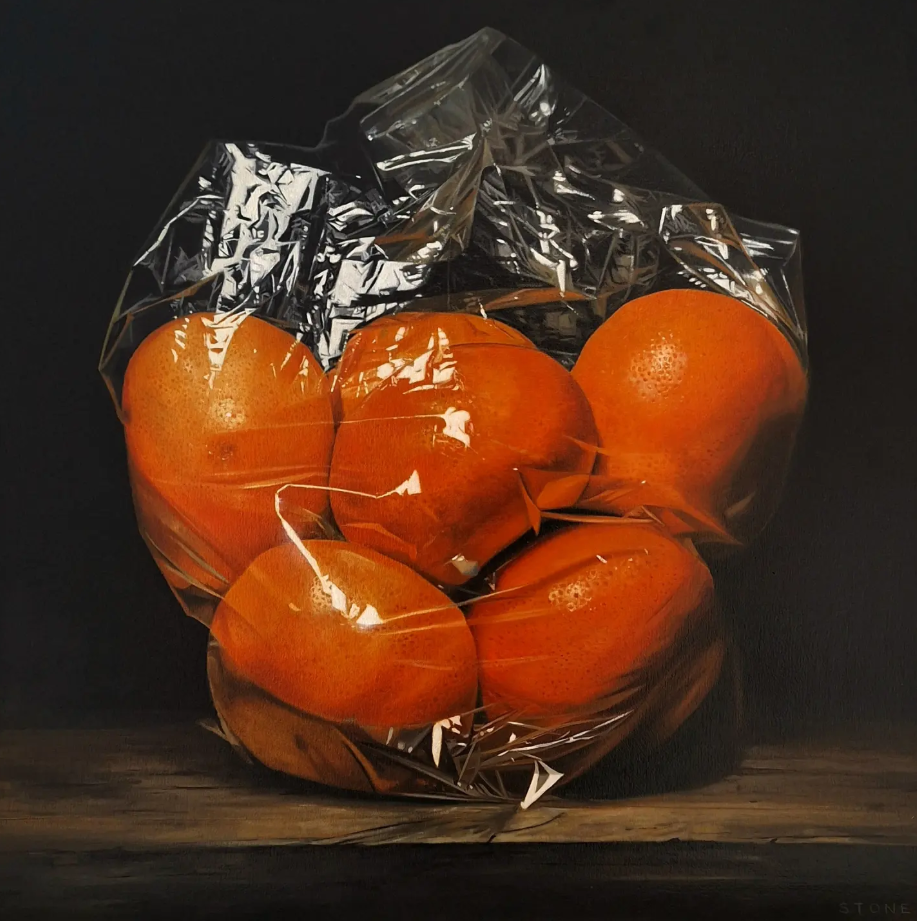
Paul Stone
M. Roomie
Emily Holland
Bagged Clementines by Paul Stone
Habitat
by M. Roomie
To Deceive the Eye
by Emily Holland
Midsummer, Saturday. I told her to be here at noon. To most, the woman goes unnoticed, as does the small painting her body obscures. Nothing special. I know this painting well, can recall each detail from memory. Gold frame, glowing crusty bread, pulpy full figs, a simple prosaic title: Still Life with Figs and Bread. She doesn't know exactly why I asked her to be here, as opposed to in front of one of the other more famous, perhaps more interesting pieces in the museum. This is the quietest wing of the gallery, tourists milling about the other limited-time exhibits of seminal artists and their contemporaries. Maybe she arrived early to pace through the other wings, get her fill of the art before our meeting. She did not ask questions, though I have my reasons for this room, this painting. I like to withhold at the start.
From the entryway, I watch her examine it. She moves closer to the canvas. Attentive. Her mouth opens slightly, as if she is trying to tell herself what she sees there among the dark browns and greens. If I didn’t already know what she looked like, from the six photos uploaded to her online profile, I would not have even known she was waiting for anyone. She looks complete, whole. Somehow, I feel that I am a disturbance.
I don’t always meet my dates out like this. Usually, I offer something more predictable—a coffee meetup or a stroll through the monuments along the water, when the weather is nice. Museums are a second or third date activity. Too intimate for an uncertain beginning. I have grown bored of the usual sights, bored of recycling the same topics of conversation and arriving at the same foregone conclusions. I have grown bored, too, of this whole dating thing, the slow rhythm of messages back and forth, the tension rod pulled tight between two people who don’t yet know each other but are figuring out if they want to try. Control is something I am hesitant to give up. As is often the case, I go in search of swift gratification: time spent with a beautiful woman who can carry an interesting enough conversation online to pull me back into the real world, the world of right now.
It is still so empty in this wing. My steps punctuate every slow movement with a deep marble echo. She tilts her head, acknowledging that I am here, though she cannot know me for certain. I like this game. I could be anyone in the space until we meet.
She is tall, with chestnut brown hair cascading down her shoulders. It is longer than in her photos, where she often styles it pulled back while hiking or doing some other nature-intensive activity. I like that she enjoys the outdoors. I imagine her hands rough, calloused, practiced, but could not bear the idea of an isolated hike with someone I’d only flirted with in a few brief messages. In some of the photos she posted, her hair is barely shoulder length. Time passes, that is how things work. She keeps her attention on the painting now. Restraint, maybe, or fear. I get closer, and I can see gold earrings hanging low, her hand brushing hair back behind her ear. Her right ear has five, no, six piercings, each adorned with another small gold charm or tiny glistening gemstone. Quite a bit of pain, it must have been. I file that thought somewhere deep.
What do you think, I ask, easing my approach. Her eyes still don’t leave the painting, but now she must know it is me, off the app. Finally real.
I think it is beautiful, if mundane. A little tired in the brushstrokes, she says.
I keep looking at her, not needing to glance at the painting at all. I like this script we are making, something that is just ours. Her first message to me, after I asked what she thought of me, or the app version of me, was similar: beautiful, tired. Somehow I felt she could already see too much. We didn’t do the typical introductions. I only know what I need: her first name (Madison), what she looks like (in a general sense), and some basic hobbies (hiking, exploring the city, flea markets). Topics not covered: preferences in art, fear of death, and what I need to say to get her into bed. Neither of us felt compelled to ask too many probing questions. It was like we already knew each other, some kind of pulsing familiarity between us. I could tell that we had things in common, big life things, experiences, despite not even knowing where she is from. She’s pushing me now, I realize. Trying to trigger a response. So she remembers my opening question, her answer.
There’s something nice about the realism of it all, don’t you think?
At this, she turns to face me. A recognition. I search her dark brown eyes but only see myself reflected there. Double. Seeking something more.
It’s almost too real, Madison says. I want to reach out and grab the bread, tear open a fig, and consume it all.
Her hand drifts towards the canvas, its ridges of oil paint. How long did it take to dry, I wonder. How many layers are underneath?
The painting is sort of an invitation, I offer.
I’ve spent a lot of time looking at it on my own. Many quiet mornings standing alone, just thinking. Tracing the shapes with my eyes, sometimes floating a finger as close to the canvas as I’d let myself. Before the figs, it was cheese and berries. A pentimento. Madison reaches out and touches my face. Her hand is gentle. But I can feel a coursing power underneath, something aggressive in her pulse. I want to know the source of it. I push closer. Tense my jaw.
The museum guard clears his throat, enough to snap us out of our spell here in front of the painting. We make our way out to the main hall and its throng of tourists moving about the more popular rooms. Everywhere I look, there’s another overstuffed backpack, a kid tugging on a parent’s shirt. There is an ever-present heat here, the air thick with breath and sweat. Summer, the busy season. Its weight pushes down from the skylights above. Hazy. The fountain at the center of the atrium, surrounded by flowers, pulses a steady atmospheric swell. The gallery provides a brief shelter from the sun and offers up more than just an easy bathroom break or water bottle fill.
I used to come to these rooms often, while I was a student nearby. It was not crowded in those days, the threat of an evil president looming over the declining tourism industry. I could sit in the garden area for hours, with only a pen and a notebook, utterly undisturbed. I wrote poems then, took my time with myself on the page. Too much moving around now, too many hours spent working during the week. I’d always visit my favorite painting before leaving. A few minutes of looking, sometimes more. Occasionally, I’d add rough imitations of the objects in my notebooks, let them talk to my poems. Those journals sit, somewhere, artifacts of my own past waiting to be reclaimed.
Madison grabs my hand and leads me down a spiral of worn marble stairs. The dreamscape threatens to break, but I don’t want to let go just yet. I push her into a dark alcove at the base of the staircase. My hands find her hips. I feel her breath hitch. It is cooler here, outside of the light and the hot exhales of all the visitors.
Not here, she says, pushing me away.
Where, then?
This is all new, no more shared repetitions between us. I had the upper hand before. I know I am supposed to follow her now. Madison walks fast, leading me out of the museum, the sun blurring and blinding. We cut across gravel paths, dodge speeding bikers and a few ambitious joggers through the manicured lawn, away from all the people to a modern gallery. I expect her to take me inside the circular walls, to pull us into a black box theater to pretend to watch some new art film in the dark, out of the heat. A lot can happen in the dark.
Instead we walk alongside the curved brutalist architecture and duck down a quiet cut-through covered in plants. Suddenly silence all around, save for the hum of insects. An oasis. I see a butterfly bush covered in bumble bees. A small bird bath. All of it green and glistening. Everything breathes at the same time, and yet the humidity isn’t oppressive. I stop to look closer at a few plants, labels low to the ground, covered in overgrowth. Bear’s Breeches. Lenten Rose. Strawberry Begonia. A rather provocative looking one hanging around us called Dutchman’s Pipe attracts flies with its rotting flesh color. Further back, a yucca’s spikes tower over the lower vegetation. One of the plants has large leaves that, as I get closer, reveal a network of sharp spines along their fronds. There is danger here, among the beauty. Madison sits on a bench, near the small fountain, leaving space for me.
I love it in here, she says and I sit beside her.
The bench, wood, is forgiving in the heat. It is nice, the sanctuary, but I don’t say anything. She doesn’t need that from me, just as I didn’t really need her input on the painting. These are our tests for each other. Her hand brushes some hair behind her ear, a repetition, flashing the piercings. I wonder again of the pain, the healing. Something in me drives my hand up, mirroring hers. I touch the outside of her ear, run my thumb behind where I can feel sweat beading. Her jaw clenches and releases, a sharp breath in. She turns. Like a bird, I startle, jerk my hand back, see the glint of her sweat on my fingertips. Then, my fingers to my lips, her sweat there. Mouth dry with want, I hesitate to lick it off. She is watching me, but I don’t dare look directly at her. There is a monarch, finally, on the bush planted for it. I watch it flutter, taking in the sweet pollen with each dip of its tongue. Mine passes over my lips, Madison’s sweat nearly evaporating, leaving behind only salt. I take her in, slow, deliberate, feeling her eyes on me still. I point, wanting her to see what I see, the fleeting beauty. It surely won’t survive the summer storm on the horizon. The monarch lifts away, wings heavy in the thick air, but it manages to fly down the lane, graceful.
I used to collect butterflies, I say. I wanted to give Madison this one new thing about me. Some kind of currency between us. Not the live ones, I add, but their carcasses. Moths, too. Their wings are so delicate. I wanted to know how they could hold themselves together.
Silence, again. Maybe she is thinking, maybe I shared something too vulnerable, too soon. I shift on the bench, inching just slightly away, mumble something about being a weird kid, but don’t worry, I’m not like that anymore. Sudden movement. Could be the butterfly returning. Except then Madison kisses me. I cannot say anything more to explain myself because I am kissing her too, soft at first, easing into the heat. My hands, her face, I do not let go. We breathe together, each taking and giving back with our inhales and exhales.
All desire leads somewhere, that was what the poets taught me.
Yorkshire-based artist Paul Stone became a full-time painter in 2008, bringing to his practice a first-class degree in History of Art and a Master’s in Contemporary Fine Art Practice from Sheffield. Working from South Yorkshire, he has developed a sustained and focused body of work, each year building upon an established foundation. Stone specialises in still life painting, drawing on the familiar objects of daily life and presenting them with a distinctly contemporary clarity. Working in oils within a framework of classical realism, he employs controlled light and shadow to articulate surface, texture and spatial presence. His compositions frequently combine fruit and vegetables with carefully selected found objects, lending renewed attention to the ordinary. Plain, often neutral backgrounds serve to isolate these arrangements, directing the viewer’s attention towards form and placement. Composition remains central, informed by an engagement with Spanish and Dutch still life painting of the eighteenth century, alongside later artists such as William Nicholson. His work can be found on his Instagram and can be purchased through Gladwell & Patterson.
M. Roomie is a project created by Raleigh, NC based songwriters Aubrey Claire Kruszka and Jessi Krauss Verrill. They love to write music based around unique vocal harmonies, catchy melodies, layered guitars, cryptic lyricism, and arrangements that take you somewhere. Some of their influences include Slow Pulp, Pinegrove, Soccer Mommy, and Boygenius. They round out their band to a 5-piece, with 3 guitars, bass, drums, and duo-lead vocals, lending to an energetic live show. At the heart of their project is a love for creating, authenticity, and having fun, which comes through in everything they do, from handmade T-shirts to DIY music videos to frequent collaboration with friends. In the digital age of convenience and instant gratification, they are committed to keeping AI completely out of their work and prioritizing human connection over social media.
Emily Holland (they/she) is a genderqueer lesbian writer. They are the author of Notifications On (Washington Writers’ Publishing House, forthcoming 2027). Emily’s work appears in publications including HAD, Shenandoah, DIALOGIST, and Black Warrior Review. They are the Executive Editor of Poet Lore, America’s oldest poetry journal.